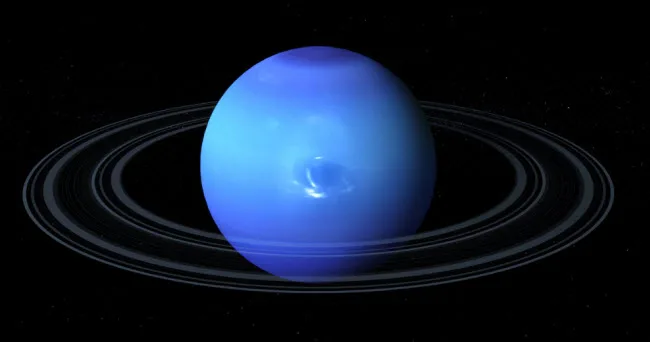
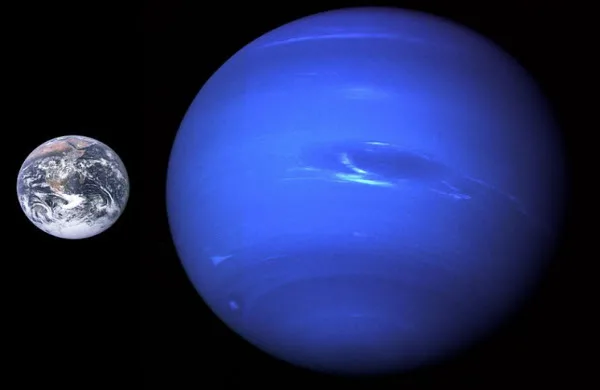
Neptune is the eighth and farthest planet from the Sun in the Solar System, and the fourth-largest planet by size. Its diameter is approximately four times that of Earth. It is an ice giant, much like its twin-like neighbor Uranus, although Neptune is denser. Like the other giant planets, Jupiter and Saturn, Neptune has no solid surface. Its atmosphere consists mainly of hydrogen and helium, along with icy materials such as water, ammonia, and methane.
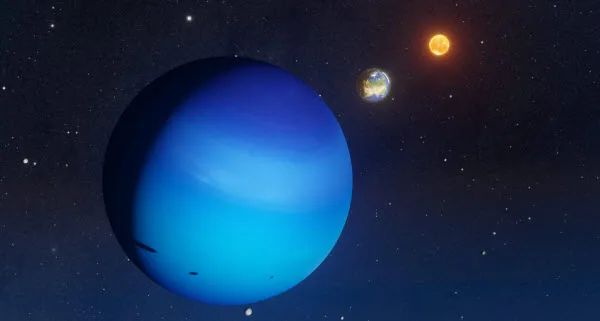
Neptune is the only planet discovered through mathematical predictions rather than direct observational evidence before its discovery. Because of its great distance from Earth, it is difficult to study using conventional ground-based telescopes. The planet is so far from the Sun that sunlight reaching it is about 900 times fainter than the sunlight we receive on Earth.
Like Uranus, Neptune has an internal core made of ice and rock. However, unlike Uranus, Neptune does not have a hazy atmosphere and displays active weather patterns. It experiences the strongest sustained winds of any planet in the Solar System, with speeds exceeding 2,000 kilometers per hour. Neptune is also one of the coldest planets, and its deep blue color is believed to result from an unidentified component rather than methane alone, as is often suggested for Uranus.
Neptune was named after the Roman god of the sea. Its discovery followed the observation of unexpected changes in Uranus’s orbit, which led astronomer Alexis Bouvard to suspect that an unknown planet was exerting gravitational influence on it. After his death, astronomers John Couch Adams and Urbain Le Verrier used his observations to calculate the likely position of the unknown planet more accurately. Neptune was finally observed through a telescope in 1846 by astronomer Johann Galle, at the location predicted by Le Verrier.
Neptune currently has 14 known moons. The largest, Triton, was discovered just 17 days after the planet itself. Triton is the only large moon in the Solar System known to orbit its planet in the opposite direction to the planet’s rotation. This suggests that it may once have been an independent object captured by Neptune’s gravity. Triton is extremely cold, with temperatures reaching approximately −235°C. Despite this, geysers have been observed on its surface, ejecting icy material up to eight kilometers into the air. Its atmosphere has also been observed to warm, although the reason remains unknown.
In addition to its moons, Neptune has at least five main rings and four prominent ring arcs identified so far. The main rings, listed from the planet outward, are named Galle, Le Verrier, Lassell, Arago, and Adams.
How Big Is Neptune, and How Far Is It from the Sun?
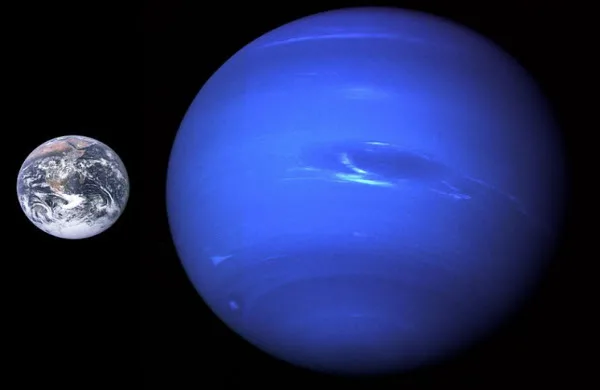
Neptune has a radius of approximately 24,622 kilometers, making it about four times larger than Earth. If Earth were the size of a coin, Neptune would be about the size of a baseball. The planet lies an average of 4.5 billion kilometers from the Sun, equivalent to approximately 30 astronomical units, with one astronomical unit representing the average distance between Earth and the Sun. At this distance, sunlight takes about four hours to travel from the Sun to Neptune.
What Are Neptune’s Orbit and Rotation Like?
One day on Neptune lasts approximately 16 hours, which is the time it takes the planet to complete one rotation on its axis. Neptune takes about 165 Earth years, or approximately 60,190 Earth days, to complete one orbit around the Sun.
Sometimes Neptune is farther from the Sun than the dwarf planet Pluto is. Pluto follows an unusual, highly elliptical orbit that brings it inside Neptune’s orbital distance for a period of about 20 years during each 248-year orbit around the Sun. This occurred most recently between 1979 and 1999. Despite this orbital overlap, the two planets are unlikely to collide because of their repeating orbital resonance: for every three orbits Neptune completes around the Sun, Pluto completes two. This pattern prevents the two bodies from approaching too closely.
Neptune’s rotational axis is tilted by approximately 28 degrees relative to the plane of its orbit around the Sun. This is similar to the axial tilts of Earth and Mars, meaning Neptune experiences seasons just as Earth does. However, because its year is so long, each of its four seasons lasts for more than 40 years.
How Did Neptune Form?
Neptune formed along with the rest of the Solar System about 4.5 billion years ago, when gravity pulled together swirling gas and dust to create this ice giant. Like Uranus, Neptune may originally have formed closer to the Sun before migrating into the outer Solar System about four billion years ago, eventually settling into its current orbit as the eighth planet.
Neptune’s Internal Structure
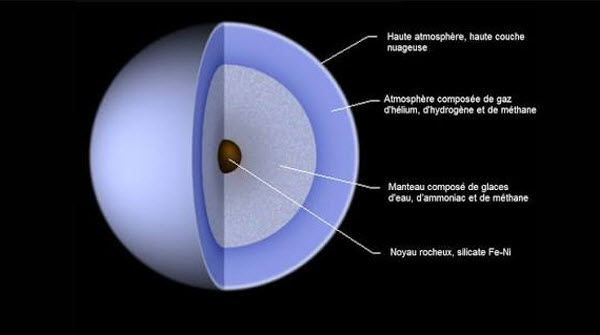
Neptune and Uranus are classified as ice giants of the outer Solar System. Approximately 80% or more of Neptune’s mass consists of a hot, dense fluid containing icy materials such as water, methane, and ammonia, surrounding a relatively small rocky core. Temperatures near the core may reach about 5,100°C.
Among the giant planets, Neptune is the densest. Scientists believe that an extremely hot ocean of water may exist beneath Neptune’s cold clouds. Despite its high temperature, this water may not boil because the enormous pressure keeps it confined.
As an ice giant, Neptune has no solid surface. Its atmosphere, composed mainly of hydrogen, helium, and methane, extends to great depths and gradually merges into a hot, dense mixture of water and other icy materials above the solid core, whose mass is approximately comparable to Earth’s.
Neptune’s atmosphere consists primarily of hydrogen and helium, with a smaller amount of methane. Like neighboring Uranus, Neptune appears blue, but its color is more vivid. Scientists therefore suspect that an unidentified component contributes to its intense, bright blue appearance.
Neptune is also the windiest planet in the Solar System. Its winds are believed to be about three times stronger than Jupiter’s and nine times stronger than Earth’s. These winds sweep frozen methane clouds across the planet at speeds exceeding 2,000 kilometers per hour.
In 1989, a large oval-shaped storm was observed in Neptune’s southern hemisphere. It was named the Great Dark Spot and was large enough to contain the entire Earth. The storm subsequently disappeared, although another storm later appeared in a different region of the planet.
Does Neptune Have a Magnetic Field?
Neptune’s magnetic field is tilted by approximately 47 degrees relative to its rotational axis. For comparison, Uranus’s magnetic axis is tilted by about 60 degrees relative to its rotation axis. Because of this misalignment, Neptune’s magnetic field undergoes changes during each rotation. Its magnetic field is approximately 27 times stronger than Earth’s magnetic field.
Could Life Exist on Neptune?
Neptune’s environment is not considered suitable for life as we know it. Its extreme and fluctuating temperatures, pressures, atmospheric conditions, and chemical composition make it an environment in which living organisms would find it extremely difficult to survive and adapt.