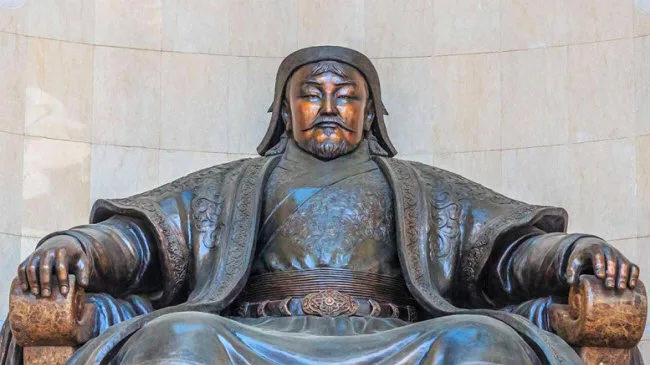
Genghis Khan was a Mongol warrior and ruler and one of the most famous conquerors of all time. Known for his extraordinary military and leadership abilities, he used them to establish the largest contiguous empire in history after uniting all the nomadic tribes of Mongolia under his rule and that of his family within a strictly disciplined military state. He then turned his attention toward the kingdoms beyond the borders of his world and launched brutal campaigns of conquest that allowed him to control vast territories stretching from China‘s Pacific coast to the Adriatic Sea in Europe. Despite his conquests, his reign became notorious for the unprecedented destruction inflicted upon the lands he invaded, causing major demographic changes and a sharp decline in population as a result of mass killings and famine. Some historians estimate that the number of people who died as a result of his conquests ranged from 40 to 60 million. Nevertheless, modern Mongolians regard him as the founding father of their nation because he was a unique ruler who developed his empire by encouraging trade and establishing the first international postal system. Genghis Khan is also credited with bringing the Silk Road under a single, cohesive and relatively stable political environment, facilitating communication and trade between northeastern Asia, the Muslim south, and Christian Europe and thereby broadening the cultural horizons of all three regions.
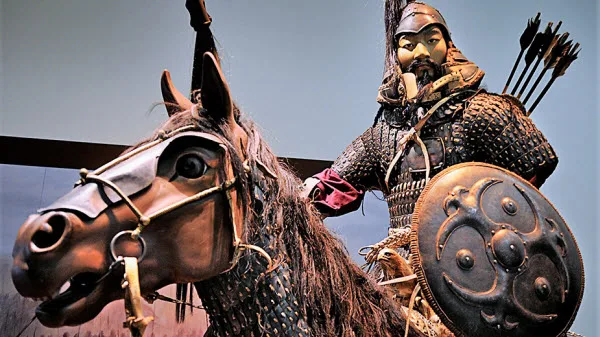
His Early Life
Genghis Khan was born in north-central Mongolia in 1162 and was originally named Temüjin, after a Tatar chieftain whom his father, Yesügei, had captured. The young boy belonged to the Borjigin clan and was descended from Khabul Khan, who had briefly united the Mongols against the Jin dynasty in northern China in the early 12th century. According to The Secret History of the Mongols, Temüjin was born with a blood clot in his hand, a sign in Mongolian folklore that he was destined to become a leader. His mother, Hö’elün, taught him the harsh realities of life in a turbulent Mongolian tribal society and the importance of forming alliances.
When Temüjin was nine years old, his father took him to live with the family of his future bride, Börte. During his journey home, Yesügei encountered members of a rival Tatar tribe who invited him to a reconciliation feast. Instead, they poisoned him in retaliation for his previous actions against them. Upon hearing of his father’s death, Temüjin, who was still known by that name at the time, returned to his tribe to claim his position as clan leader. However, the tribe refused to recognize the leadership of the young boy, and his family, including his younger brothers and half-brothers, was abandoned by the clan. On one occasion, a dispute arose over the spoils of a hunting expedition, and Temüjin killed his half-brother Bekter, asserting his authority as head of the family.
At the age of 16, Temüjin married Börte, strengthening the alliance between the Onggirat tribe and his own. Soon afterward, Börte was kidnapped by the rival Merkit tribe and given to its leader as a wife. Temüjin managed to rescue her, and shortly afterward she gave birth to their first son, Jochi. Although Börte’s captivity cast doubt on Jochi’s parentage, Genghis Khan accepted him as his son. He eventually had four sons and several other children with other wives, as was customary among the Mongols. However, only his sons by Börte were considered eligible to inherit the family leadership.
The World Ruler
When Temüjin was 20, he was captured during a raid by former family allies, the Taichi’ut. He was temporarily enslaved but soon escaped and joined his brothers and other members of various clans to form a fighting force. This marked the beginning of his slow rise to power. He built a large army of more than 20,000 men and began dismantling the traditional divisions between the different tribes, uniting the Mongols under his rule.
Through a combination of exceptional military tactics and ruthless brutality, Genghis Khan avenged his father’s death by destroying the Tatar army responsible for poisoning him. He ordered the execution of every Tatar male taller than roughly one meter. He then defeated the Taichi’ut, who had once captured him, through a series of massive cavalry attacks and ordered the tribal chiefs to be burned alive. By 1206, Temüjin had also defeated the powerful Naiman tribe, giving him control over central and eastern Mongolia.
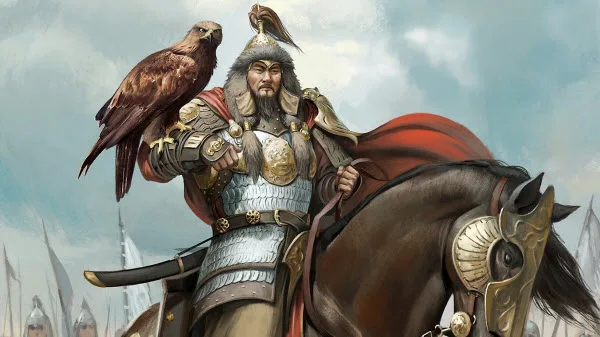
These victories were largely attributed to Genghis Khan’s brilliant military tactics and his understanding of the way his enemies thought. He employed extensive spy networks among them and was quick to adopt new military technologies compared with his rivals. He also built a highly trained army of 80,000 soldiers who communicated through sophisticated signaling systems using smoke and burning torches. His troops were fully equipped with bows, arrows, armor, and daggers. They also carried large waterproof bags containing food, tools, and spare clothing, which could be inflated and used as flotation devices when crossing deep, fast-flowing rivers. Cavalrymen carried short swords, spears, body armor, and maces. The army also benefited from a well-organized supply system using ox-drawn carts loaded with food for the soldiers, as well as doctors and spiritual advisers who provided medical and spiritual assistance. Strict rules governed the recording and distribution of spoils. Together, all these elements made his army a devastating military force.
Following his successive victories over rival Mongol tribes, the remaining tribal leaders agreed to peace and granted Temüjin the name Genghis Khan, meaning “Universal Ruler.” The title had not only political significance but also spiritual importance, as he was regarded as the Mongols’ supreme divine ruler to whom the world was expected to submit. Although religious tolerance was permitted within the Mongol Empire, challenging the Great Khan was considered equivalent to challenging the will of God.
Genghis Khan and His Major Conquests
Genghis Khan wasted no time in using his perceived divine status. His spiritual authority helped inspire his armies to begin expanding, while other factors also played a role, including environmental pressures, as food and resources became scarce with population growth. In 1207, he led his armies against the Western Xia kingdom, forcing it to surrender two years later. In 1211, his armies attacked the Jin dynasty in northern China. The Mongols were not particularly impressed by the artistic and scientific wonders of these great cities; instead, they were more interested in the seemingly endless rice fields and the spoils of war.
Although the campaign against the Jin dynasty lasted nearly 20 years, Mongol forces were also active in the west against neighboring empires and the Islamic world. Genghis Khan initially used diplomacy to establish trade relations with the Khwarazmian Empire, a Turkic-dominated empire that included parts of Turkestan, Persia, and Afghanistan. However, the Mongol diplomatic mission was attacked by the governor of the city of Otrar, who may have believed that the caravan was a cover for a spying mission. When Genghis Khan learned of the insult, he demanded that the governor be handed over to him and sent a diplomat to deliver the demand. Shah Muhammad, the ruler of the Khwarazmian dynasty, not only rejected the request but also challenged him by sending back the severed head of the Mongol diplomat.
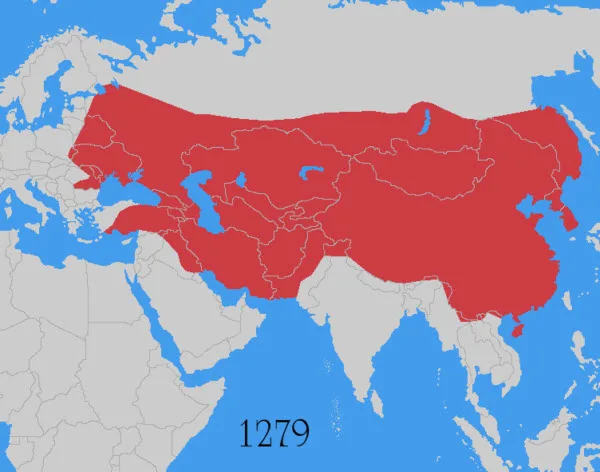
This act provoked Genghis Khan’s fury, and he decided to invade Central Asia and Eastern Europe. In 1219, he personally planned and led an attack with an army of 200,000 Mongol soldiers against the Khwarazmian Empire. The Mongols overwhelmed the fortifications of city after city with unstoppable brutality. Those who were not immediately slaughtered were driven ahead of the Mongol army and used as human shields. When the Mongols captured the next city, nothing living was spared, including small domestic animals and livestock. The skulls of men, women, and children were piled into enormous pyramidal heaps. City after city fell, and eventually Shah Muhammad was captured, while his son was later killed, bringing the Khwarazmian dynasty to an end in 1221.
After destroying the Khwarazmian dynasty, Genghis Khan once again turned his attention eastward toward China. The Tangut leaders had defied his orders to contribute troops to the Khwarazmian campaign and had openly rebelled against him. He nevertheless succeeded in defeating them and looting their capital, and the leaders soon surrendered one after another, bringing the resistance to an end. Genghis Khan ordered all of them executed, thereby ending the Tangut dynasty.
The Empire Genghis Khan Left Behind
Over time, Genghis Khan’s conquests connected the major trading centers of China and Europe. His empire was governed by a legal code known as the Yassa, which included decrees prohibiting blood feuds, adultery, theft, false testimony, and the sale or kidnapping of women. It also included laws reflecting the Mongols’ respect for the environment, such as prohibiting people from bathing in rivers and streams and requiring any soldier following another to pick up anything the first soldier dropped. Violations of these laws were generally punishable by death.
Genghis Khan also adopted a writing system and granted diplomatic immunity to foreign ambassadors. Promotions and advancement within the military and government were not based on traditional lines of inheritance or ethnicity but on merit and ability. Religious leaders and certain professional groups received tax exemptions, while a high degree of religious tolerance reflected the longstanding Mongol tradition of viewing religion as a personal belief that should not be subject to laws or interference. Numerous religious groups existed throughout the empire.
The Death of Genghis Khan
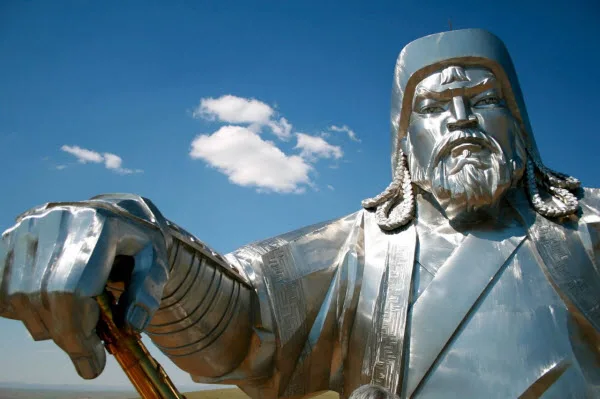
Genghis Khan died in 1227, shortly after his campaign against the Tanguts. The exact cause of his death remains unknown. Some historians say that he fell from his horse while hunting and died from exhaustion and injuries, while others believe that he died from a respiratory illness. According to the customs of his tribe, he was buried in an unmarked and unknown location near his birthplace along the Onon River and the Khentii Mountains in northern Mongolia. According to legend, everyone who accompanied the funeral was killed to conceal the location of the burial, and a river was diverted over Genghis Khan’s grave to make it impossible to find.
It is also worth noting that before his death, Genghis Khan gave supreme leadership to his son Ögedei, who went on to control much of East Asia, including China. The rest of the empire was divided among his other sons. Chagatai took control of Central Asia and northern Iran, while the youngest, Tolui, received a smaller territory near the Mongol homeland. Jochi, who had died before Genghis Khan, had controlled the western territories, which were later ruled by his son Batu, including much of modern Russia. The empire continued to expand and reached its greatest extent under Ögedei Khan. Mongol armies invaded Persia, the Song dynasty in southern China, and the Balkans. Only when the armies reached the gates of Vienna in Austria did the principal commander, Batu, receive news of Ögedei’s death and get summoned back to Mongolia. The campaign subsequently lost momentum, marking the furthest extent of the Mongol invasion of Europe.