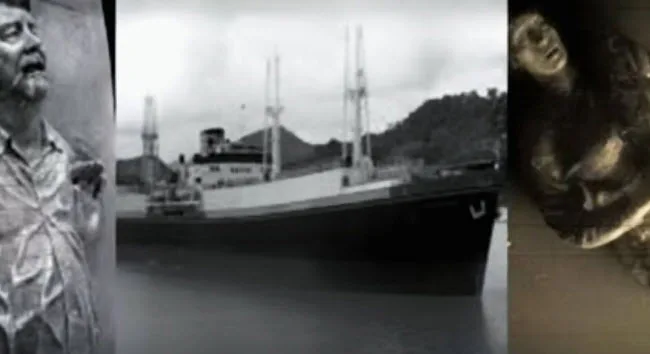
Many eerie stories tell of ghost ships, such as the Flying Dutchman and the Mary Celeste, whose tales have been passed down through generations. Yet, as strange and frightening as these haunted vessels may be, other ships have become associated with even more terrifying accounts: crews found dead under mysterious circumstances. One such case is the Ourang Medan, according to widely circulated reports from the mid-twentieth century. These accounts describe several ships sailing in Southeast Asia picking up a chilling distress call from the vessel. The message reportedly stated that all officers, including the captain, were dead and that the rest of the crew might also be dead. This was followed by an unintelligible burst of Morse code and a final message: “I am dying.” After this cryptic announcement, silence fell like a tomb.
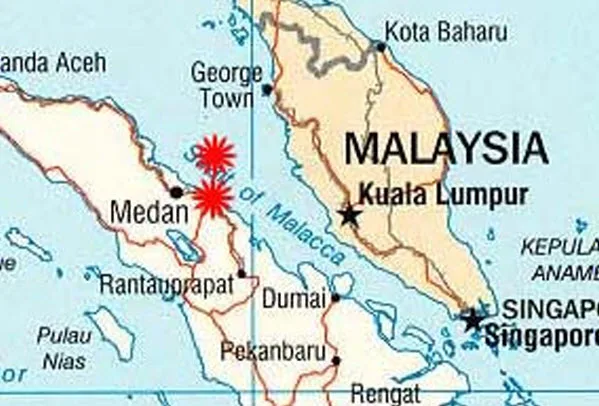
The frightening legend of the Ourang Medan began in May 1947—or February 1948, according to other accounts—when a distress call was reportedly picked up in the Strait of Malacca, between the Indonesian coast of Sumatra and Malaysia. Two American ships, along with British and Dutch listening stations, allegedly received the transmission. Its source was identified as a Dutch cargo ship called the SS Ourang Medan, reportedly located in that area. The captain of the Silver Star and his sailors, who were sailing near the reported coordinates, quickly headed toward the vessel to offer assistance. Within hours, the ill-fated ship came into view. As the Silver Star approached, its crew noticed no signs of life on deck. They repeatedly tried to signal the ship but received no response. The captain therefore sent a boarding party to investigate, unaware that its members were about to encounter one of the most horrifying sights of their lives.
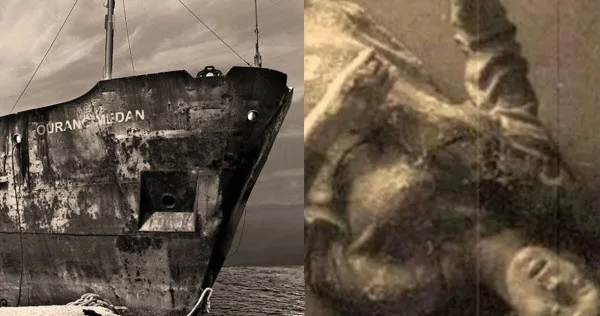
As the boarding party stepped onto the Ourang Medan, the men quickly realized that the distress calls had not been exaggerated. The decks were covered with the bodies of crew members whose eyes were wide open and whose arms were outstretched, as though they were trying to grasp invisible attackers. Their faces appeared to show a mixture of pain and terror. Even the ship’s dog was dead. The captain’s body was found, while the bodies of his officers lay scattered around the bridge. The communications officer was still at his station, dead like the others, with his fingertips resting on the telegraph.
According to the reports, all the bodies displayed the same horrifying expressions. Members of the rescue party also claimed to have felt an intense cold inside the ship’s hold, despite the extremely high temperature outside. Although the search party found clear signs that the Ourang Medan‘s crew had suffered greatly in their final moments, they could find no obvious injuries on the bodies and no visible damage to the ship itself.
The captain of the Silver Star eventually decided to tow the vessel back to port. But as soon as the crew attached a towline, smoke reportedly began rising from the lower decks. The ship then exploded with such force that it was lifted out of the water before quickly sinking. The Silver Star‘s crew watched as it disappeared beneath the sea, grateful that the towline had not dragged their own vessel down with it. From then on, the Ourang Medan became one of the most enduring and intriguing maritime mysteries of the modern era.
Although rumors about the horrific discovery spread widely along the trading routes of the East Indies, the incident did not appear in an official document until May 1952, when it was reportedly mentioned in the Proceedings of the Merchant Marine Council, published by the United States Coast Guard. The account described the disturbing condition of the Ourang Medan‘s victims, stating:
“Their frozen faces were turned toward the sun and staring, as if in fear, while their mouths were open and their eyes gazed without purpose.”
The central question remains: what really happened to the Ourang Medan? Researchers investigating the story found no official records documenting the incident. Although the Silver Star was said to have attempted a rescue, no documentary evidence has been found that establishes the existence of the Ourang Medan. Some researchers have speculated that, if the ship was real, it may have originated from Sumatra, part of Indonesia. The word orang means “person” or “man” in Indonesian, while Medan is the largest city on Sumatra. Although the name might offer a clue about the ship’s origins, no records of the vessel have been found. Historians reportedly checked the usual sources but could find no mention of it in maritime shipwreck records or the records of its supposed country of origin. The trail to the truth behind the so-called death ship seemed to end there.
Further investigation uncovered a 32-page booklet printed in Germany in 1954 by an author named Otto Mielke, titled Death Ship in the South Sea. The booklet reportedly described the Ourang Medan, including its cargo, engine power and even the alleged name of its captain. This raises the question of whether the author had spoken to someone from the Silver Star‘s rescue party who had recounted the story. According to the booklet, the ship sank in June 1947.
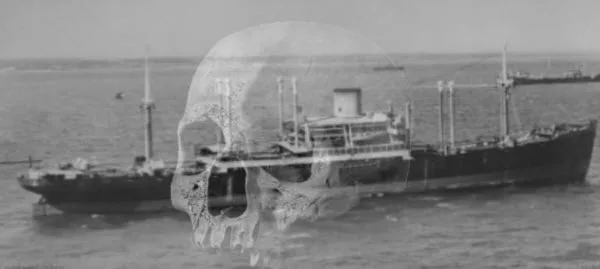
The most intriguing detail was the suggestion that Cargo Hold No. 4 may have contained lethal and illegal substances, including potassium cyanide, nerve gas and nitroglycerin. This theory led some to speculate that the ship’s records had been deliberately concealed to hide the nature of its cargo. It also offered a possible explanation for the crew’s deaths and the vessel’s eventual explosion.
According to this theory, the substances may have been weapons developed by Japanese scientists who conducted horrific experiments during World War II. These researchers were associated with Unit 731, which became notorious for its human experimentation. It has been alleged that, after the war, the Americans granted some of these scientists immunity from prosecution in exchange for access to their chemical and biological weapons research.
The theory proposes that the United States may have wanted to obtain these materials but found it difficult to transport tons of them openly by aircraft. The cargo was therefore supposedly loaded onto an old, neglected vessel with a low-paid foreign crew to provide cover. During the voyage, seawater may have entered the hold and reacted with the dangerous cargo, releasing toxic gases that suffocated the crew. The incoming salt water may then have reacted with the nitroglycerin, triggering an explosion that ultimately sank the ship. Because of the alleged nature of the cargo, the theory further suggests that the United States erased evidence of the Ourang Medan to avoid scrutiny or accusations of violating international agreements concerning such weapons.
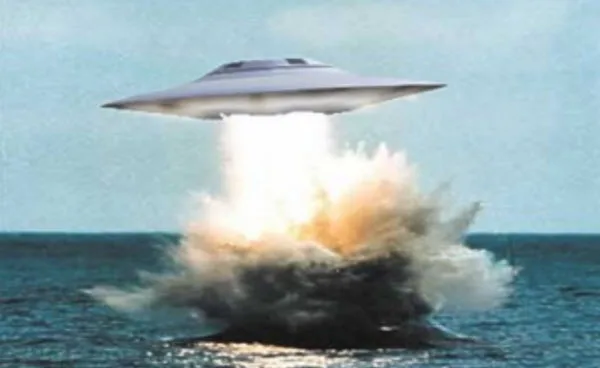
Although the theory involving dangerous cargo may seem to offer a logical explanation, it is not the only one. Some believers in the paranormal suggest that the ship was attacked by extraterrestrial beings for unknown reasons, or that its unfortunate crew encountered ghosts haunting those waters. They point to the apparent lack of a natural explanation for the deaths, the supposedly frozen expressions of terror on the sailors’ faces, the unusual cold reportedly felt in the cargo hold, and claims that some of the dead appeared to be fighting an invisible opponent.
Apart from these supernatural explanations, other theories attempt to use scientific reasoning. Some suggest that the crew suffocated after being exposed to clouds of harmful methane escaping through a crack in the seabed. The gas may have poisoned the sailors before the ship was eventually swallowed by the sea. Critics of this explanation argue that it does not account for the tremendous explosion described by the Silver Star‘s crew.
Another possibility is that a boiler fire aboard the ship released carbon monoxide, suffocating the crew before a subsequent explosion destroyed the vessel. This hypothesis has also been considered unconvincing because it does not fit the Silver Star crew’s account.
A final theory suggests that the entire story was fictional and that no ship called the Ourang Medan ever existed. According to this interpretation, sailors may have invented the tale to explain a long period spent at sea, after which writers embellished it into an enduring legend.
Whatever the truth—and whether the Ourang Medan was a real vessel or a product of imagination—it remains one of the most puzzling and frightening maritime mysteries associated with the twentieth century.