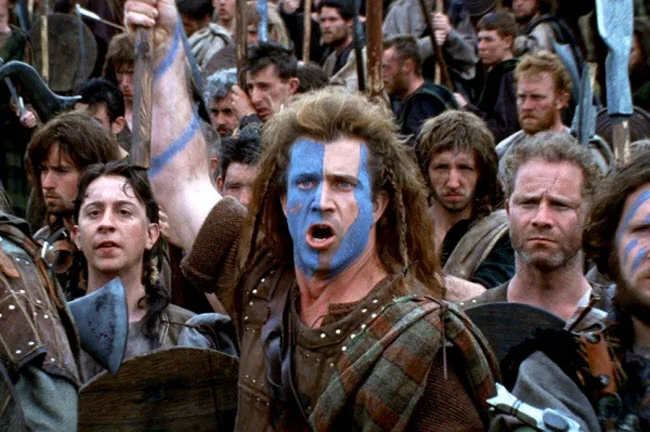
Braveheart is a work of cinema released in 1995. It tells a historical epic set during the Middle Ages in the United Kingdom, highlighting the struggle of the Scottish people, led by a folk hero named William Wallace, to achieve their country’s complete independence from the English Crown.
Through its events, the film illustrates the truth behind the saying that great fires can start from the smallest sparks. A Scottish uprising breaks out after a woman is killed by an officer serving in an English garrison in Scotland. The woman is William Wallace’s wife, and the loss of the person he loves ignites a fire of anger within him, driving him to fight fiercely for revenge—not only against the perpetrator but against everyone behind him, even if that means confronting a king and an army. What begins as a personal matter becomes the driving force behind a much larger national cause.
The film also highlights the major differences between the concept of a revolutionary leader, who believes in an all-or-nothing approach and seeks to achieve his goals honorably on the battlefield, and the mindset of politicians and nobles, whose decisions are based on negotiation and securing the greatest possible gains, most of which are purely personal. They rely on devious methods that can amount to betraying not only individuals but the entire cause, such as withdrawing at the height of a battle and leaving its hero to fight alone.
The film also conveys the idea that enthusiasm and courage may win you some battles, but they are unlikely to win you an entire war, especially against a stubborn opponent such as the King of England. The film portrays him as someone who consistently relies on conspiracies and schemes to achieve victories and expand his dominion rather than fighting wars in his colonies, because he knows that the land always favors its own people. Wallace, known among his peers as Braveheart, understands these characteristics of the land well and uses them to achieve a series of victories.
The film also shows that believing in an ideal such as freedom is not something a person can easily abandon, even under the pressure of torture. This is what happens to the film’s hero when attempts are made to force him to renounce what he believes in.
Plot Summary (Warning: Spoilers Ahead)
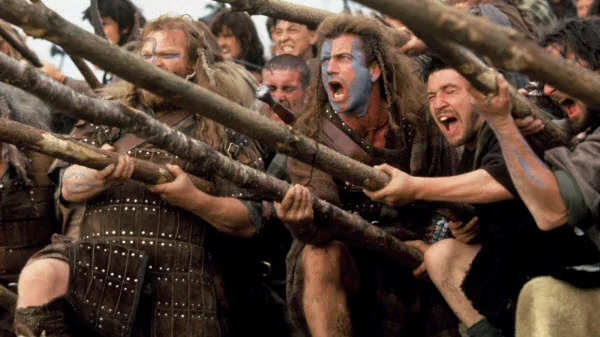
In 1280, King Edward, known as “Longshanks,” invades Scotland following the death of King Alexander III, who left no heir to the throne. Young William Wallace witnesses Longshanks executing numerous Scottish nobles. He also suffers the loss of his father and brother, who fought against the English. He is then taken abroad on a journey across Europe by his uncle, Father Argyle.
Years later, Longshanks grants his nobles lands and privileges in Scotland. Around the same time, the now-grown Wallace returns to his homeland and falls in love with his childhood friend Murron. The two secretly marry. Wallace later rescues her from an attempted rape by English soldiers, but while he is fighting them, she is captured and publicly executed. Seeking revenge, Wallace leads his clan against the English garrison in his hometown and then begins a general rebellion against Longshanks’s rule.
Longshanks orders his son, Prince Edward, to stop Wallace by any means necessary while the king is away visiting the King of France to secure an alliance between England and France. However, events take the opposite turn, and Wallace wins a series of victories against the English. As his legend spreads and he earns the nickname “Braveheart,” hundreds of Scots from neighboring clans join him. He leads them to victory at the Battle of Stirling Bridge, where he beheads the English commander Cheltham.
Prince Edward fails to send reinforcements to York, allowing William Wallace to sack the city and kill Longshanks’s nephew, whose severed head is sent to the king. Meanwhile, Wallace seeks the help of Robert the Bruce, the son of the noble Robert the Elder, who suffers from leprosy and is a contender for the Scottish crown. However, his father, wishing to secure the Scottish throne for his son, decides to submit to the English Crown.
Meanwhile, concerned about the threat posed by the rebellion, Longshanks sends his son’s wife, Isabella, from France to negotiate with Wallace and distract him from the landing of another invading force in Scotland.
After meeting Wallace in person, Isabella becomes fascinated by him. She warns him of the coming invasion, while Wallace urges the Scottish nobles to take immediate action to confront the threat and reclaim their country. He asks Robert the Bruce to assume leadership.
Longshanks personally leads the English army against the Scots at Falkirk. During the battle, the Scottish nobles Mornay and Lochlan withdraw their men after being bribed by Longshanks, resulting in the defeat of Wallace’s army. Wallace is even more shocked when he discovers that Robert the Bruce had been fighting alongside the English king. After the battle, Robert sees the damage he helped inflict on his homeland, reprimands his father, and vows never to be on the wrong side again.
William Wallace subsequently kills Mornay and Lochlan for their betrayal and launches a guerrilla war against the English, with the help of Isabella, with whom he has a romantic relationship.
Robert arranges a meeting with Wallace in Edinburgh, but Robert’s father conspires with other nobles to capture Wallace and hand him over to the English. Upon learning of the betrayal, Robert disowns his father and banishes him.
Isabella takes revenge on Longshanks, who is terminally ill and can no longer speak. She tells him that his bloodline will be destroyed after his death because she is pregnant with Wallace’s child. She promises to ensure that her husband, Prince Edward, spends as little time as possible on the throne before Wallace’s child replaces him.
In London, William Wallace is brought before an English judge and tried for high treason. He is sentenced to public torture and beheading. Wallace refuses to submit to the king while being tortured before a large crowd. Deeply moved by the courage of the Scots, the judge offers Wallace one final chance: he only has to say the word “mercy” to receive a quick death.
Instead, Wallace cries out the word “freedom,” which is heard by the dying Longshanks. Before his beheading, Wallace sees a vision of his wife Murron in the crowd, smiling at him.
In 1314, Robert, now King of Scotland, leads an army that is supposed to formally accept English rule. Instead, he recalls Wallace and urges his men to fight alongside him as they once fought with Wallace. Robert and the Scots repeat Wallace’s name as he leads them into battle against the English, ultimately winning freedom for Scotland.
Cast
- Mel Gibson — William Wallace
- Sophie Marceau — Isabella
- Patrick McGoohan — King Longshanks
- Angus Macfadyen — Robert the Bruce
- Catherine McCormack — Murron
Awards
The film won five Academy Awards: Best Picture, Best Director for Mel Gibson, Best Cinematography, Best Makeup, and Best Sound Effects. It also received five additional nominations, along with 33 other awards.
Behind the Scenes
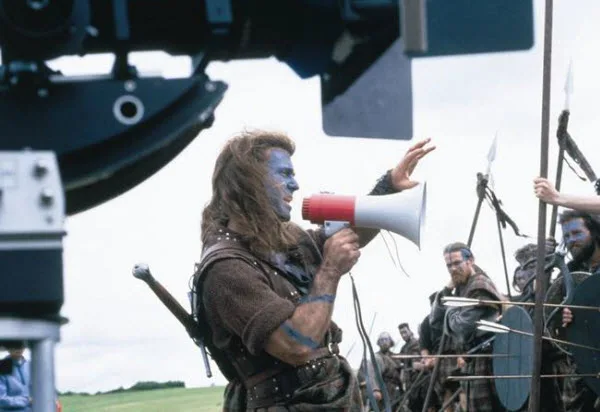
- Mel Gibson initially refused the role of William Wallace because he felt he was too old for the character. However, Paramount Pictures stipulated that it would not finance the film unless Gibson played the lead role, so he eventually agreed.
- During the filming of Braveheart, one exhausted extra mistakenly thought that Mel Gibson’s son, who was among the people on set, was one of the young workers and asked him to fetch a cup of tea. Gibson was nearby, nodded, and whispered to his son, “Go and get it.”
- In an October 2009 interview with the Daily Mail, Mel Gibson admitted that Braveheart was highly fictionalized. However, he claimed that the changes had been made for dramatic purposes. He also said that he had always felt at least a decade too old to play Wallace.
- King Edward I was nicknamed “Longshanks” because he was at least 1.88 meters tall, unusually tall for a man of that era. William Wallace was even taller, standing at 1.96 meters.
- Many Scots were offended by the film’s portrayal of Robert the Bruce because he is regarded as a national hero.
- Mel Gibson later said of Braveheart: “Some people said that we ruined history in telling the story, which doesn’t bother me, because what I’m giving you is a cinematic experience. I believe films exist first to entertain, then to teach, and then to inspire. There may have been historical inaccuracies because there was very little history available about the man. I read about him, and he wasn’t as nice as he was in the film. But we romanticized him a little because that is the language of cinema, and you have to make it cinematically acceptable. In reality, he was a monster because he was always smelling the smoke from the villages he burned. But we tried to balance things a little, because he had to be a character with both good and evil in him.”
- As many as 1,600 people were used in the battle scenes, most of them members of the Irish Army Reserve.
- Although Mel Gibson was nearly 40 during the filming of Braveheart, he was portraying a character in his twenties.
- Despite featuring scenes set in the Scottish Highlands, almost the entire film was shot in Ireland.
- Several major battle scenes had to be reshot because the extras were wearing sunglasses and wristwatches.
- The Irish did historically fight against William Wallace. However, Mel Gibson decided to portray the Irish as joining the Scots because modern audiences might have been confused by seeing the Irish and English on the same side. Scottish and Irish actors also refused to fight one another.
- Although they played father and son, James Cosmo, who played Campbell, and Brendan Gleeson, who played Hamish, were only seven years apart in age.
- Screenwriter Randall Wallace initially planned to begin the story with William Wallace as an adult. He added the childhood introduction only as an afterthought.
- Mel Gibson was investigated by an animal-welfare organization that was convinced the fake horses used in the film were real. The organization was persuaded otherwise when one of Gibson’s assistants provided footage of the filming locations showing that the horses were indeed artificial.
- William Wallace’s real wife was named Marian. It is believed that her name was changed to Murron to avoid confusion with Robin Hood’s wife, who had the same name.
- In 1983, screenwriter Randall Wallace visited Edinburgh to learn about its heritage. Outside Edinburgh Castle, he came across a statue of William Wallace. He had never heard of the figure before, but the stories he was told about Scotland’s greatest hero fascinated him enough to make him research Wallace’s story as thoroughly as possible.
- The film’s initial cut contained considerably more violence than the final version. Concerned about negative reviews resulting from the excessive violence, Mel Gibson personally edited the film to tone down those scenes.
- Actor Brian Cox, who played Argyle Wallace, William’s uncle, was initially offered a larger role. However, he preferred the role of Argyle because he felt it was better suited to him.
- Historically, Prince Edward did not marry Princess Isabella until 1308, after both William Wallace and King Edward I had died.
- The film’s story takes place between 1280 and 1314 AD.
- Filming the Battle of Stirling took six weeks.
- Glen Nevis, the name of the Scottish valley used as the location for William Wallace’s childhood village, receives heavy rainfall. During the six weeks spent filming there, the sun appeared on only three days, when the wedding scene was completed. The filmmakers eventually accepted that the continuous rain was unavoidable and chose to shoot the remaining scenes in the rain.
- Instead of using digital effects, Mel Gibson decided to film real arrows flying through the air.
- Mel Gibson said that making Braveheart was more physically exhausting for him than filming three movies from his famous Lethal Weapon series.
- It was said that Mel Gibson offered $5 to anyone who could spot the fake horses in the finished film. In reality, he did not need to honor the bet, because the scene in which a horse falls into a ditch clearly looked fake: the animal remained motionless where it fell, did not move its legs, and made no attempt to get back up, unlike a real horse.
- Catherine McCormack, who played Murron, said that people still ask her, “What does it feel like to kiss Mel Gibson?”
- Mel Gibson enjoyed working at a location far away from Hollywood because most of the film’s production took place without studio executives interfering.
- Sean Connery turned down the role of King Edward I, “Longshanks,” because he was filming Just Cause (1995).
- Extras were paid only $300 a week and regularly worked 14-hour days.
- Screenwriter Randall Wallace had little historical evidence to work with concerning William Wallace’s life. He relied heavily on a romantic 15th-century poem by the Scottish poet Blind Harry when writing the story.
- Princess Isabella did not set foot in England until 1308, so she could not have been in England to warn Wallace about the impending Battle of Falkirk.
- No one knows whether the real William Wallace ever addressed the Scots before a major battle. Screenwriter Randall Wallace said, “I wrote what gave me goosebumps.” Although there is no evidence that such a speech took place, his stirring speech—especially the line, “They may take our lives, but they’ll never take our freedom!”—has become one of the most famous quotations in film history.
- Mel Gibson refused to grow a beard to play William Wallace.
- Mel Gibson originally wanted to use the Cross of Saint Andrew, the Scottish symbol seen on the country’s modern flag, as the design for his face paint during battle. However, the film’s makeup artist, Lois Burwell, suggested the iconic design covering half of his face.
- Mel Gibson originally wanted Jason Patric or Brad Pitt to play William Wallace. Daniel Day-Lewis, Liam Neeson, Christopher Lambert, Jeff Bridges, and Robin Williams were also considered for the role.
- Angus Macfadyen was initially called in to audition for Prince Edward. During the audition, he asked to try out for Robert the Bruce instead, and he got the role.
- The hanged men were real actors, suspended from safety harnesses throughout the day to film the scene.
- The opening shot of Braveheart was the first shot Mel Gibson filmed.
- Mel Gibson’s brother, Donal Gibson, played the leader of one of the clans that joins William Wallace midway through the film.
- Braveheart contained so many complicated fight scenes that Mel Gibson hired two professional stunt performers to carry them out.
- In the scene in which young William Wallace expects his father and brother to return from battle, he wakes to the sound of a cart pulled by two large, long-horned oxen. The animals were obtained from a zoo in England. Named Edward and Philip, they each weighed approximately one ton and were transported to the filming location in Glen Nevis, Scotland.
- Two weeks before winning his two Academy Awards for Best Picture and Best Director, Mel Gibson was in the hospital undergoing an appendectomy.
- Jodie Foster was considered for the role of Princess Isabella of France and Murron, William Wallace’s wife.
- Mel Gibson wore a wig to play William Wallace.
- During post-production, Mel Gibson and editor Steven Rosenblum struggled over a massive 195-minute cut (three hours and 15 minutes), which was too long for the theatrical release. Paramount executive Sherry Lansing intervened and suggested which parts she felt needed to be removed. Both men were initially angry and resented the intervention, but after making some revisions, they eventually agreed that Lansing’s suggestions were right and reduced the running time to two hours and 58 minutes.
- William Wallace’s evisceration was filmed in painstaking detail, but it was not shown clearly on screen because the filmmakers anticipated negative audience reactions to the scene.
- Mel Gibson briefly hanged himself during the filming of his character’s death scene. He said, “I remember waking up with all these people standing over me.”
- In the film, Wallace is ambushed, beaten, and captured at Edinburgh Castle after being betrayed by Robert the Bruce’s father. In real life, Wallace was betrayed by a Scottish noble loyal to King Edward, Sir John Menteith.
- The Times voted the film the second-most historically inaccurate movie. The main points of contention were that William Wallace was a landowner and minor noble in real life but was portrayed in Braveheart as a poor commoner; that he had no relationship with Queen Isabella, who was only five years old when he died; and that the film included anachronistic clothing and customs, such as kilts and face painting, as well as inaccurate battle tactics. Other historical errors included the fact that England had occupied Scotland for only a year before Wallace’s rebellion, that Robert the Bruce—not Wallace—was the person actually known as “Braveheart,” and that although Bruce frequently changed sides, he never directly betrayed Wallace. Longshanks also died during a campaign two years after Wallace’s execution. Screenwriter Randall Wallace and director and actor Mel Gibson acknowledged these departures from historical reality, but maintained that they were inspired by the legends surrounding Wallace and wanted to tell a compelling cinematic story rather than deliver a history lesson.
- It is rumored that in the original screenplay, during Wallace’s death scene, his ghost appeared after his beheading, walked toward Murron, and then they walked away together.
- When King Edward killed Philip, he decided to throw him out of a window, even though he could have killed him with his sword. According to the film’s explanation, this was because, at that time, death by the sword was considered an honorable death reserved for nobles, knights, and kings. Common people had no right to use or fight with swords. Had Edward used his sword to kill Philip, he would have granted him an undeserved honorable death.
Box Office
The film cost $72 million to make and earned more than $213.2 million.