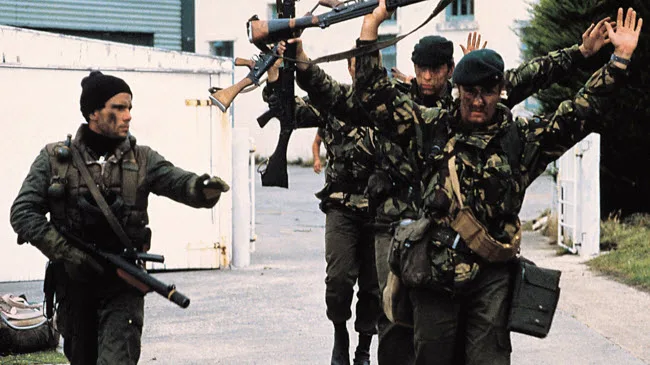
Some countries’ influence extends far beyond their own borders, sometimes reaching thousands of kilometers away, because certain territories hold major strategic importance for them. As a result, giving up such places can be extremely difficult, even when they are technically claimed by another country. This was the case with the United Kingdom, which went to war against Argentina in the 1980s in what became known as the Falklands War, after Argentina seized control of the islands and detained several members of the small British garrison stationed there. The scene shown in this photograph was considered deeply humiliating and prompted the British to respond with a major military operation.
Date: April 2, 1982.
Photographer: Argentine photographer Rafael Wollmann – Gamma French photo agency.
Details: The story behind this photograph dates back to the outbreak of the Falklands War in 1982, a conflict between Argentina and the United Kingdom over a group of islands in the South Atlantic known as the Falkland Islands. The islands were under British sovereignty, but Argentina claimed them as its own. On April 2, Argentine forces invaded and occupied the islands, and the small British garrison stationed there surrendered. Britain responded quickly on April 5 by dispatching a naval task force, which took several days to reach the South Atlantic. British forces engaged the Argentine navy, followed by attacks and an amphibious landing on the islands. The conflict continued for several weeks, leaving 750 Argentines and 256 Britons dead. It ended with Argentina’s surrender on June 14, after which the islands returned to British control.
In the days leading up to the war, photographer Rafael Wollmann had been assigned by his agency to travel to the Falkland Islands to prepare a documentary report. He arrived on March 23 and began working on his assignment. On April 1, while sitting in the bar of the hotel where he was staying, he heard the island’s governor, Sir Rex Hunt, whom he had met during his work, announce over the radio that there were signs of an imminent Argentine invasion. The other people in the bar then began looking suspiciously at Wollmann because he was the only Argentine there. The governor later contacted him personally and told him that he had to leave the hotel and would be sheltered at the home of the governor’s driver, where he was instructed to remain regardless of the circumstances.
Once the war began, suspicions and accusations followed Wollmann around the island, with some people believing that he was an Argentine spy. The suspicions were intensified by the fact that he had mailed the photographic film he had taken back to Argentina two days before the invasion. From the driver’s house, he began photographing and documenting the invasion and the clashes between the British garrison and Argentine forces. At one point, he narrowly escaped death when an unidentified soldier fired at him after apparently mistaking his camera for a weapon. The bullet passed only a few centimeters from his head.
Wollmann later learned that the governor had surrendered and was to be transferred into exile in Uruguay. He therefore moved to the governor’s residence, where he witnessed British soldiers surrendering to Argentine forces, as captured in the photograph. According to Wollmann, after surrendering, the British soldiers sat in the governor’s garden as though they were prisoners of war. He quickly left the area because he feared being arrested or having his camera confiscated. On April 3, Wollmann left the Falkland Islands and returned to Argentina.
Once he arrived back home, local newspapers and magazines competed for the rights to publish his photographs. Wollmann later joked that he had managed to earn enough money from the pictures to pay for his house almost overnight. He then handed the photographs over to his agency in France, where they attracted intense interest from major French magazines, including Paris Match and VSD, both of which competed for the rights to publish them. VSD eventually secured the rights and used one of the photographs as its cover under the headline “England Humiliated.”
Because of the impact of the photograph, some have argued that it, along with a number of other images from the conflict, helped push Margaret Thatcher to take decisive action and send British forces to retake the Falkland Islands. Wollmann later commented on the photograph: “For the English, the picture was horrifying. Many people cried because it was so powerful and had such a huge impact.”